Monday, 28 April 2014

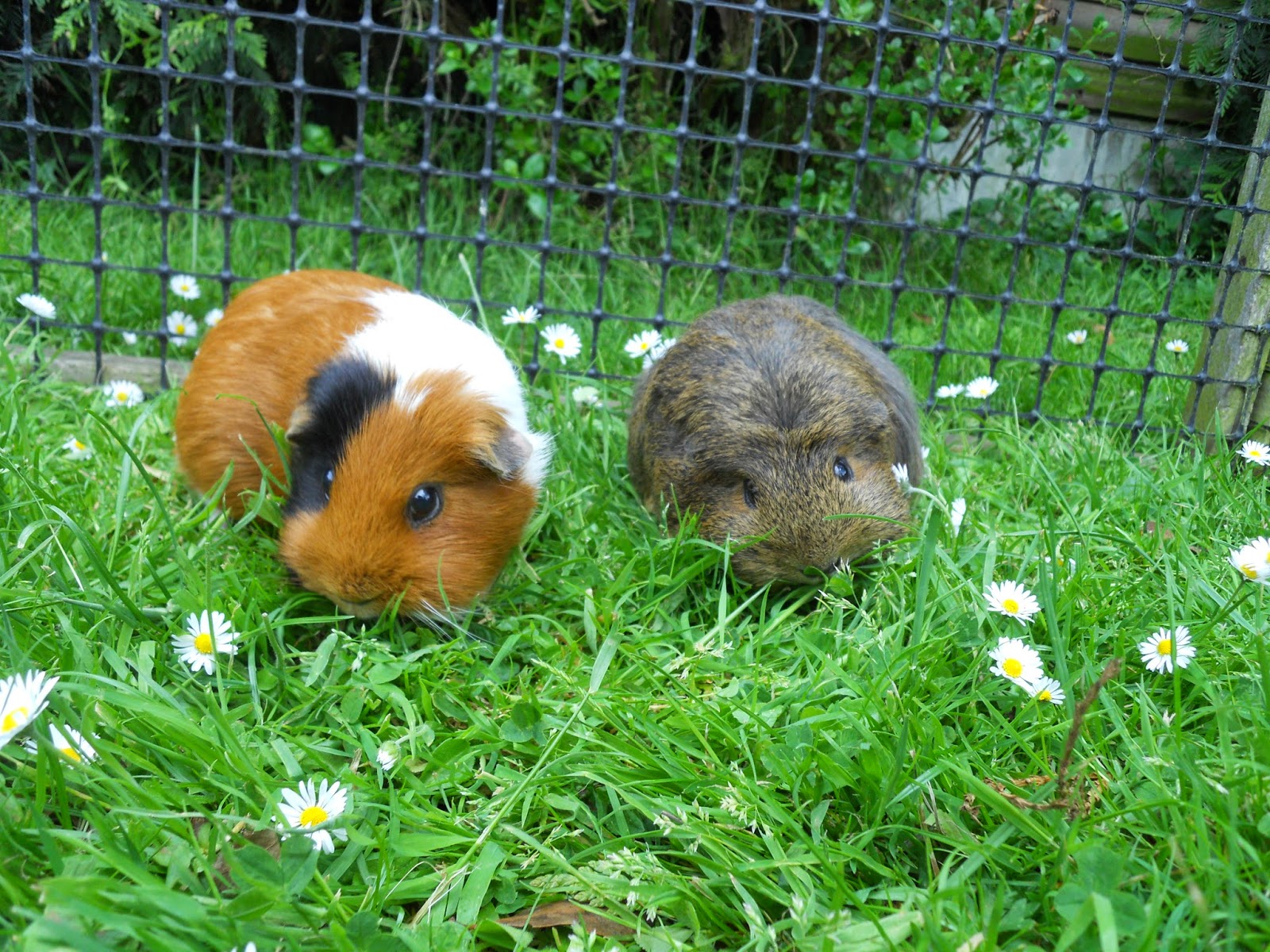
National Pet Month - The Guinea Pig


This month from April 1- May 5 is National Pet Month and all those who own a pet know that they soon become a vital part of the family. They are there at those important milestones, celebrate the successes in our lives and comfort us when we're upset. What's great about our furry/scaly friends is that they never judge and have an unconditional love for those they are close to in their lives.


First domesticated in Peru, the guinea pig has been around for thousands of years and made its way to Europe in the 1500s where they were raised as exotic pets. In fact, Queen Elizabeth I was among one of the first guinea pig owners in Europe.

There are 13 known guinea pig breeds and these include the Abyssinian, English, smooth coat, silkie and teddy. They are all similar in size, except for the Texel, and are of medium length with large round eyes and a Roman nose. Dependent on their breed, they may have a smooth coat, short hair or long hair and come in a range of colours such as chocolate, beige, silver, golden, brindle, roan, dalmatian or tortoiseshell.


Guinea pigs eat a variety of grass, fruits and vegetables in order to keep healthy, but it is important to ensure they are given extra vitamin C because their bodies cannot produce it themselves. They are one of the few mammals, other than humans, that require extra vitamin C to keep healthy. An adult needs 15-25mg each day, while pregnant females require 30mg. Guinea pigs that are ill or injured can need up to 100mg to help them get better.

Vitamin C can be provided in the form of food pellets which are available in all petshops. These pellets are much better than the normal food mixtures because your pet cannot pick and choose the parts that they like. This way all the food is the same and gives them all the nutrients they need.

Their digestive system breaks down food quickly, so they need to eat almost constantly. In addition, it is important to provide them with hay because this helps to keep their intestines healthy. It also enables them to wear their teeth down and is a good substitute for the plants and grasses that their wild cousins have access to. In addition, they enjoy vegetables including brussel sprouts, red or green peppers, parsley, dandelion and broccoli leaves.

Other foods such as avocado, chocolate, dairy products, iceberg lettuce, meat, onions, potatoes, raw beans and nuts or seeds should be avoided because they can be toxic.


As guinea pigs are prey animals, they can move quite fast. When you go to pick up your guinea pig, always support their legs and spine because they can be prone to back problems. It will also help them to feel secure and so they won't want to leap out of your arms, especially when you take them to and from their hutch!

I've been lucky to have looked after my friend's guinea pigs on a number of occasions and they're always so friendly and happy to see me. Well, especially if food is involved! They are very sociable pets and I love the way they make noises to illustrate their mood.

They are also naturally curious and so it is important to provide them with toys and spend time with them in order to keep them happy.


Fun Fact: Unlike other pets, such as hamsters, guinea pigs are diurnal which means they are awake at the same time as us and they sleep when we sleep. Although, they certainly like to take a nap or two during the day, too!

Sunday, 6 April 2014

How Much Does Your Pet Mean To You?


We all love our pets, whether they are tiny, huge, scaly, feathered or furry, and it's our duty to provide them with the best care we can to keep them happy and healthy. However, it's not all one way and it has actually been proven that most pet owners are happier in their own lives because they share it with a pet.

To celebrate the second year of the National Office of Animal Health's (NOAH) 'I Heart My Pet' campaign, researchers conducted a study of more than 2,000 pet owners to see just how our animals affect us in our day-to-day lives. They found that approximately 90 per cent of those interviewed claim to be happier as a result of having a pet and 48 per cent of people believed that spending time with their pets reduced their stress levels.


I've had rabbits since I was eight years (I'm nearly 24 now!) and I have to say that they have certainly enriched my life. I got my rabbit Simba just over two years ago and he's such a character. I've bought him in overnight every day since the winter because of the horrible weather we've had and there's nothing better than going into the kitchen to have my breakfast and seeing him waiting for me to open his hutch door. Even though he can't talk back, those morning chats while we're eating breakfast (me with my shreddies and him with a leaf of cabbage) help get the day off to a great start.


NOAH also found that more than one in five people surveyed said they are at their happiest when they spend time with their pet. My grandad passed away a few years ago and my nan would have been very lonely on her own. Her lhasa apso Daisy helps to distract her and keep her busy. She's a bundle of fluff and when we go and visit, she always carries my bag inside!

I can say the same about one of my friends who is elderly. He lost his wife a couple of years ago and he has a pet lurcher called Penny. I believe that having Penny during this difficult time has helped to keep him going.


It was enchanting to read that some of the findings of this survey paints a picture of a nation of Doctor Dolittles. This is because they found that almost two thirds of owners believe they can understand the noises their pet makes and 49 per cent say they are able to read their pet's facial expressions. In addition, 48 per cent think they know when their pet is happy or sad.

I love this idea and think all pet owners roughly know how their pet is feeling at a certain time. Sometimes, when I'm grooming Simba's mane (he's a lionhead) he puts on a long-suffering face as if to say 'Go on then, if you have to.' When I've taken Penny out for a walk, she'll bark at my friend and he knows whether she wants to go out into the garden or if she wants some food.

I think when we spend so much time with our pets, we do develop a kind of a relationship with them. It works the other way, too. If I'm sad, Simba will come up and just lay next to me, just to let me know that he's there and he'll let me stroke him for as long as I need to.


The final results of the survey discovered that 12 per cent believe their pet is the most important person in their lives and and one in 10 women would turn to their pet before a partner with a problem.

This shows just how much we value our pets and reinforces that they are full-fledged members of the family. I think they are just as important as any other member, more so because they depend on us to look after them and take them to the vet when they are ill. Last year, Simba broke his leg and me and my family spent £500 so that the vet could help make him better. While this is a lot of money, I believe he was worth it because as an pet owner I have a duty to look after him.


The National Office of Animal Health (NOAH) has a new website (www.pethealthinfo.org.uk), which offers expert healthcare advice for pet owners, as well as activities to help keep pets happy and healthy all year round. Follow the campaign @Iheartmypetuk on Twitter or find IHeartMyPetUK on Facebook.

Saturday, 8 March 2014

Pets - Keep Calm and Stress Free


At the end of last year (I can't believe we're already in March), I wrote a post about trying to keep your pets calm and relaxed throughout November and the New Year. As we all know, this is the season for fireworks and the bangs and flashing lights can often leave your pet feeling stressed and frightened.

Two people I know have dogs that really suffer when fireworks are let off and nothing seems to help keep them calm. Last November I was sent some Pet Remedy products, which are designed to tackle stress and I thought I would see if this could help. I gave my horse riding instructor Teresa two Pet Remedy plug in diffusers and my sister's work colleague Debbie a diffuser and a mini spray.


Teresa's 13-year-old creme coloured labrador Oscar reacts badly to fireworks. When they go off, he shakes uncontrollably, his breathing becomes rapid which makes him sweat and, in addition, a muscle spasm occurs in his hindquarters which causes paralysis. One time, he resorted to eating through a door frame.

Before the diffusers Teresa would try to hug him and keep him close when the fireworks were let off, but he would just shake even more. She tried some pills from the vet, but there was no change. She also purchased a 'thunder coat' for him, which is worn like a normal dog coat, and although these helped a bit, there was only a minute difference. Teresa also tried another diffuser, igloos for him to hide in and put the TV on loudly, but none of these helped. He would also not eat for the whole firework period, which amounted to a whole month.

When Teresa used the diffuser, and sprayed the 'thunder coat' with this solution, she noticed an immediate effect. Although, Oscar still shook, it was not enough to cause paralysis in his hindquarter and he thankfully kept eating throughout this period.


Debbie, my sister's work colleague, owns a male labradoodle called Harvey. In November last year, he was just under six years old.

Harvey's normal reaction to fireworks is complete panic. This would result in pacing, panting, scratching and digging, as well as slight aggression. He then developed a general noise phobia and became nervous around all loud noises.

During the firework period Debbie and her family would talk to Harvey calmly, try to distract him with loud music and play with interactive toys. She also tried Harvey in a 'thunder coat', built him a safe den and tried a range of medication such as diazepam, calmeze and zylkene.

The Pet Remedy was used in addition to Xanax tablets as prescribed by a vet. Harvey seemed a lot calmer when the diffuser was used and Debbie was able to give half the maximum does of Xanax for Harvey's weight. It lasted for more than three weeks and Debbie now uses the diffuser when she leaves Harvey home alone.


Teresa also has another dog called Archie, who is a 13-year-old fox red labrador. When fireworks go off he paces and hides, hence why Oscar chewed through a door frame to get to his brother. Although he still eats, he will only have a limited amount and is usually affected by his stressed out brother. 

As like Oscar, Teresa tried to hug Archie to keep him calm, but it made him worse. Medication from the vet, a 'thunder coat' and different diffuser had no effect on him. He did not appreciate the igloos Teresa bought for him to hide in and the TV on loud and the lights out did not make any difference either.

Both the Pet Remedy diffuser and the 'thunder coat' sprayed with this solution helped Archie. It was particularly evident to see when Oscar was also relaxed. Nothing else works on Teresa's dogs to keep them calm and she will continue to use this in the future. 


Pet Remedy is a natural way of tackling stress and anxiety and helps to keep your pet calm without the need for sedation. It can be given to a range of different animals, including dogs, cats, rodents, horses and birds. 

This solution uses a blend of natural oils to calm the nerves when they are overstimulated in times of stress. It is available as a plug in diffuser and calming spray. For more information, visit: www.petremedy.co.uk www.facebook.com/petremedy or call 01803 612 772.

Saturday, 8 February 2014

2014 - The Year of the Horse


I think 2014 is going to be my favourite year so far.This August,  I'm going to Australia for a wedding and can't wait to see all the koala bears, kangaroos and hopefully spot Nemo and Dory if I'm lucky enough to go scuba diving.

However, the other reason why 2014 is great because just a few days ago on Chinese New Year, it was named the Year of the Horse.

Now everyone who knows me is aware of how much I love horses, but how did they evolve into the ones we see today?


Fifty-five million years ago, when marine reptiles became extinct, mammals began to evolve which brought about the ancestors of animals such as the elephant, rhino, ox, pig, monkey and the horse.

During this period it was at its smallest at a mere 12 inches tall and was called Hyracotherium, which is derived from the Greek word for hog. With four toes on its forefeet and three on its hind, it died out some 40 million years ago after it failed to adapt to the changing geographical locations as the world around it changed.


This ancestor was succeeded by Orohippus and then Epihippus which was similar in shape, but its teeth became more efficient and enhanced. Later on, these were both eclipsed by an animal three times the size of Hyracotherium, which was called Equus and had grown to about 13 hands (62 inches) high.

Originating from America, this horse moved south and spread to Asia, Europe and Africa. While this also became extinct, different species then emerged and became the exclusive ancestors of those that we see today.


These three ancestors were known as the Steppe, Forest and Plateau. The Steppe had a large head with long ears and a long face. Its body was short and supported by slender legs and long narrow hooves. Agile, it was able to scramble over most obstacles and its feature remain largely unaltered in the wild horse of Mongolia, otherwise known as Przewalski's Horse.


The Forest type was heavier and more thickly-built. With a long body, short strong legs and broad rounded hooves it was able to walk on marshy ground without sinking. This is thought to be the ancestor of the 'cold blooded' heavy horse.


Then there is the Plateau. This horse had a small narrow head, small ears, large eyes and was lighter and more slender than the Forest or Steppe. This is thought to be the ancestor of the more lightweight ponies and finer-built horses of today, such as an arab or thoroughbred.


Today, the difference between a horse and a pony is defined by its height. A horse must stand more than 14.2 hands (58 inches) high. Anything less, is regarded as a pony. A creature of comfort, they come in a variety of colours from albino, bay and chestnut to dun, piebald, grey and palomino. It has four natural gaits: walk, trot, canter and gallop. My favourite is the canter, especially when attempting it with stirrups!

I could go on and on about the numerous breeds that I absolutely adore, but I've decided to restrict them to my top three.


First is the Icelandic pony. I've always wanted to go to Iceland to visit these beautiful ponies which were first introduced by the Norwegians. Just 12-13 hands high, they are usually a grey or dun colour, but can come in dark brown, chestnut and palomino.

A friendly pony, they are particularly independent and have a great homing instinct. If ridden, they can be taken out for long distances and when let loose can always find their way home. They respond better to a voice, rather than the usual aids, and is one of the toughest of all the breeds of horse.


Another one of my favourites is the wild American mustang. Between 14-15 hands high, it comes in a range of colours and is a hardy and independent breed. They used to roam the plains of North America in large herds and were frequently used by the Native American Indians.

Sadly they are in decline, but thankfully they are protected under the Wild Horse Protection Act of 1959. This allows them to be free range in specific areas at no risk of harm.


Last, but not least is the shire. Native to England, they average at about 17 hands, although they can reach 18 hands. They generally come in a brown or bay colour, but black or grey is not uncommon. They are enduring, gentle and docile with powerful shoulders and beautiful feathers from the back of their knees all the way down to their hooves.

The tallest horse in the world, sadly their numbers declined once machines were bought in after the war to use on farmland. Now they are fairly ornamental in their roles within the show ring or as a team horse to pull brewer's drays. What makes them even more impressive is their ability to pull an amazing five tons.

Thursday, 26 December 2013

A Word Of Warning - The Food That Harms Our Pets


When it comes to food, our pets love to get stuck in. However, there are plenty of human foods that can harm or even kill them, which worryingly some owners are not aware of. It's even more important to keep an eye on your pets during the festive season, as there will be plenty of food around which is hard to resist.

Over Christmas, I often decide to treat myself and have chocolate for breakfast. Let's be honest, it's the only couple of days when I can't feel guilty! While we all love a bit of chocolate as a treat, this is extremely harmful to dogs and can be fatal.


It contains the stimulant theobromine, which is a bit like caffeine, and affects the the heart, central nervous system and kidneys. Chocolate that is meant for humans can even cause death in serious cases.

Out of the different varieties, dark chocolate contains the most theobromine. If your dog has eaten any, the side effects will occur between four to 24 hours depending on the amount your dog has eaten. These include muscle tension, increased heart rate, seizures, diarrhoea, vomiting, restlessness and rapid breathing. 

Sadly, there is no antidote for chocolate poisoning and all vets can do is either make your dog vomit or wash out the stomach and feed them charcoal to absorb any theobromine left in the intestines. Depending on the signs your dog is showing, they may also put them on a drip or medication to help control the heart rate, seizures and blood pressure.

So this Christmas, if your dog is going to be tempted by your chocolate, why not buy him/her some doggy friendly chocolate instead? This way, you can both have a little treat and not have to worry.


Christmas pudding and mince pies are also a big no no when it comes to dogs. Most dog owners aren't aware of this danger, but foods that contain grapes, raisins and sultanas can give your dog kidney failure. And unlike chocolate, even small amounts can kill them.

It has similar side effects to chocolate, but because this causes kidney failure dogs will also want to drink a lot more water than normal. Why not give them a toy instead, so they can have fun while you finish Christmas off with a festive treat?


The traditional turkey dinner is always one to watch out for too. While raw, uncooked bones are fine for your dog's health and teeth, cooked bones are another matter. These can easily splinter when your dog eats them, which can result in them choking. The skin should also be removed from the turkey if you feed it to your dog because it can be a source of fat. However, the white meat is very good because it is a great source of protein.


The above also applies to cats too and it is more likely they may be affected by these foods because they can jump on higher surfaces to get closer to these festive delights.

Most people believe that cats like diary products, especially milk, but this is not true in all cases. Some cats are lactose intolerant, because they lack the enzyme that helps to digest lactose - a sugar in milk. This can then result in them experiencing tummy problems and diarrhoea.

This can especially be fatal to kittens because they can become dehydrated a lot quicker than adult cats. This is because once they have been weaned, milk is no longer essential in their diet.


Don't forget about rabbits too! They enjoy a good selection of green plants and vegetables, as well as straw and hay. However, it's worth noting that although we also like a decent amount of vegetables in our Christmas/ Boxing day dinner, don't give your rabbit too many carrots.

Carrots are very high in sugar, which can not only cause problems for your bunny's waistline, but can cause them to develop dental problems in the future. Why not substitute this sugary food for the carrot tops, which are high in calcium, sprout tops, broccoli or cabbage? Of course, all this should be given in moderation, but it is much better for your rabbit and they will thank you for it in the future!
  • Pets at Home have launched a 'Change their food, change their life' campaign in order to encourage and educate owners on the right food for their pet. This takes into consideration: size, breed and life stage. 
  • In a recent survey questioning more than 3,000 pet owners, they found that 85 per cent of cat and dog owners fed their four-legged friends human food and treats on a daily basis. Cheese was the most popular, which can be harmful as some animals are lactose intolerant. 63 per cent of owners admitted to feeding this regularly to their pets. 
  • Meanwhile, 31 per cent said they gave their cats/dogs fruit, which included raisins or grapes. 27 per cent fed their pets biscuits, which can lead to obesity, and 5 per cent fed their pets chocolate. 
  • Other goods included bread, roast dinners and crisps, all of which can cause digestive problems for your pets.
So, make sure you feed your pets the food that is best for them. While they may not like it as much as your food, they'll certainly thank you for it later in life. 

On that note, I'll leave you with this picture of my rabbit Simba getting into the festive spirit. Merry Christmas and a Happy New Year! 


Friday, 6 December 2013

Animal Odd Couples - Friends For Life


Animals. They're fascinating and always find a way to constantly amaze us. Take Animal Odd Couples. This two-part series aired on BBC One explores the relationships they hold for one another, even if they are both at the opposite end of the spectrum when it comes to their species.

What's fantastic to see is they don't judge each other like humans do when it comes to size, colour, race or gender. They accept each other unequivocally and it's beautiful to watch how close a relationship they hold with one another. Whether it's friendship or maternal instinct, a different species or even a stuffed toy, sometimes these bonds can even help to save an animal's life.


For instance, take these guys. All three are animals you wouldn't expect to see this close to one another in a million years, yet here they are nuzzling each other and showing real affection towards each other.

Kept at Noah's Ark Animal Sanctuary in America, Leo the lion, Baloo the Asiatic black bear and Shere Khan the Bengal tiger all share the same territory, but amazingly get on like a house on fire. While they would also share the same territory in the wild, it wouldn't be as on a small scale like this and one would end up either seriously injured or killed.

Their background is very sad, because as youngsters they were all kept illegally as pets. What makes it difficult to comprehend is that usually when they are kept as pets this young, they have been taken out of the wild and their mother has been killed in order for the poachers to seize the babies.


I don't understand why people would want these animals as pets. I know they're exotic and that no one else has a pet like this, but they are wild animals. They should be treated as such, because one day they may have a bad day and someone ends up hurt or killed.

However, back to Leo, Baloo and Shere Khan. As youngsters, they were kept in a basement before they made their way to the sanctuary. They had never been separated and when the sanctuary tried, they cried and refused to eat until they were reunited. In this case, their friendship helped them attempt to come to terms with their early childhood and reduce the stress they felt when they were not together.


Inter-species friendships can incredibly also help to save certain animals from extinction. Sadly last year in South Africa, 688 rhino were killed for their horn. This animal is usually killed simply because traditional Chinese medicine believes that the horn holds special powers and will help cure people from illnesses. When the adults are needlessly killed, many orphan calves are left behind.

Filming in a secret location at a safe haven for wild animals, the orphan calves are given a second chance of life, using an unconventional friend if another orphaned calf is unavailable. Baby rhinos, in particular, have a very close relationship with their mum and are actually dependent on their mothers for the first two years of their life. In fact, they are so reliant on a mother figure/companion, that it is likely that they will die without them due to stress.


When it comes to pairing up the calves, humans aren't the first choice because they are not able to stay with the babies 24/7. At the centre most of the young rhinos are actually paired up with a sheep or foal instead. As well as teaching the babies to graze properly, the sheep or foal help to make the rhino feel more secure in their environment when out and about in the safe haven. This is because rhinos, especially white rhinos, have very poor eyesight and without a companion they are very insecure and nervous.

In this case, the sheep or foal help the orphaned rhinos to continue with their day to day routine and offer a life-saving solution to the threat of their extinction.


Different species can also develop a maternal instinct towards other animals and even take them in as their own. In the case of Kate, a great dane, she took in Pippin a wild, black-tailed fawn when Kate's owner discovered Pippin in the woods as a baby.

Although she left her for a couple of days initially in case her mum came back, she heard Pippin crying and so took her in. With nowhere else to put her, she laid Pippin on Kate's dog bed. As soon as she did this, Kate looked up at her as if to say "I'll take over from here." This story is so heartwarming to hear because in any other circumstances, Kate would probably have killed Pippin as her other doggy instincts took over.


However, at two-weeks-old, Pippin insisted on sleeping outside in the woods on her own as her wild nature kicked in. She would continue to come back every day to visit Kate and soon their maternal relationship developed into friends. At this time, Kate would tone down her aggression in play and Pippin was rougher than what you would normally expect during play. Amazingly, they both comprised and altered their behaviour to prevent the other one from being hurt.


However, it's not just real life animals that can be friends and even save their lives. In the case of this tiny Dartmoor foal, a teddy bear helped to save his life.

At just a few hours old, this summer Blaze was found wandering around the Dartmoor National park without his mum and was suffering from shock and dehydration. Rescuers took him to the Mare and Foal sanctuary and because he was missing his mum, he was given a four foot bear to keep him company. At night he would cuddle up at night to this giant teddy and started to be much happier in himself.

It's heartwarming to see such a tiny animal curled up with a teddy bear and in this case, Blaze didn't need another animal to help him. He just needed a presence to help him remember his mum and a teddy bear was just the right man for the job.

Here's a video of Blaze with his teddy.


Wednesday, 20 November 2013

Lest We Forget - Animals In War


Last week millions of people across the world held a two minute silence on Remembrance Day to remember the soldiers who died to give us the freedom we have today. Both wars were extremely horrific and saw severe loss of life. In World War One, an estimated 10 million people died in military action. During World War Two there were a lot more civilian fatalities, with an estimated 40 million civilian deaths and 20 million military deaths.

However, it wasn't just people who served their country during the war. Often the forgotten army of war, thousands of animals have also been at the forefront of the action, putting their lives at risk to save ours. The purple poppy represents their sacrifice, while the red poppy represents the sacrifice by our soldiers.


As dependable as soldiers, dogs played a crucial role in sniffing out enemies, carrying supplies, finding the wounded, delivering messages, ratters and most importantly companionship. The idea to use them first came from the Red Cross, who wanted to use ambulance dogs on the front line and by 1918 Britain had employed more than 20,000 dogs in war.

Messenger dogs were vital to the service because they could overcome the difficulties that soldiers and vehicles faced in the heart of battle. They were able to run a lot faster, could travel over any terrain and were less likely to be shot at by a sniper. The trenches were a complex system to navigate and messages could easily be lost, running the risk that an important letter would not make it to the front line or headquarters. Soldiers were an obvious target and vehicles were likely to break down or get stuck in the deep mud that savaged the battlefield.


Casualty dogs were also known as "mercy dogs" and were trained to find those who were wounded or dying on the battlefield. They were even equipped with medicine, so that the soldiers could tend to their wounds while they waited to be found. Sadly, in the case of those who were too far gone, the dogs simply sat and comforted them until they passed away.

Dobermans were particularly used as sentry dogs and tended to patrol the military bases with a handler, warning them with a bark when someone approached. On the other hand, scout dogs had to be very quiet and worked with soldiers by patrolling the area in front of them. As a dog's nose is so sensitive, they were able to detect an enemy scent up to 1,000 yards away and quicker than a soldier ever could. If they found someone, they would simply stiffen and point their tails to indicate that the enemy was approaching. That way the soldiers could prepare themselves and hopefully take the other side by surprise.


Dogs were not just used on the front line though. Animal Rescue Squads were set up during World War Two, when the Blitz began to terrorise London, to try and save the numerous people who were trapped under bombed out buildings. One Alsatian, Irma, saved hundreds of people and memorably two young girls who were trapped under a house. She sniffed them out and refused to move until rescuers had moved in to release the girls from the rubble.


However, it wasn't just man's best friend who helped with the war effort. Pigeons were used extensively to deliver messages during both World Wars, with 250,000 used in World War Two alone. As a result, racing with these birds was stopped and many birds of prey were killed along the coasts of Britain, so that pigeons would not be attacked while delivering an important message.

One pigeon, named Mary, delivered an important message despite being attacked by a hawk in France and returned with injuries to her neck and breast. On a different occasion, she returned with a wing tip shot off. Another pigeon called Royal Blue flew an astonishing 120 miles in 4 hours and and 10 minutes after the aircraft he was in was forced to land. He was able to pass on a message containing the location of the rest of the crew.


Horses were also used extensively during both World Wars as modes of transport, as well as pulling the heavy artillery the forces used at this time. Sadly, at the beginning of World War One, many horses were employed for use in the cavalry. Many died due to trench warfare, barbed wire (which was found across No Man's Land) and machine guns, so the forces stopped using horses in the cavalry section.

Recorded figures show that more than 8 million horses died during these wars and one factor was because once the fighting was over, there was no way to bring them home. Only 62,000 actually made it back to England, which is a devastating thought. These horses had carried soldiers through the heart of battle, often coming across weapons that were miles more advanced that what Britain used and then at the end of this, they were simply discarded.


At the time, there was a shortage of horses going into the war and so many were forced to give up their farm horses for the war effort. This is highlighted in the theatre production "War Horse", which has been given excellent reviews worldwide. Based on the book by Michael Morpurgo, the play centres around a young man Albert, whose horse Joey is taken away to fight in the war.

Albert follows him out there and every move he makes is in the hope that eventually he will find Joey again. I won't tell you the ending of this story, but I can assure you that I shed many tears throughout as the plight of Joey and the millions of horses used in the war is told.

This was also made into a film by Steven Spielberg and I would recommend both the the play and the film because they are both individual interpretations in their own right. While Spielberg's film is magnificent and features beautiful scenery, the play is also special because as it continues, you forget that there are people operating the puppets and the horses aren't real.


As a result of the bravery shown by all the animals who served in war and just after World War Two, the PDSA's founder Maria Dickin introduced a medal especially for animals. The Dickin Medal is essentially the animals' Victoria Cross and is awarded to those animals who are devoted to duty while serving or who are associated with the Armed Forces or Civil Defence Units. This is the highest honour any animal can receive while serving in war.

Since 1943, this medal has been awarded 64 times to a grand total of 32 pigeons, 28 dogs, three horses and one cat. And what a fitting tribute it is to all those animals who have contributed to the war effort both her and abroad.